Address
304 North Cardinal
St. Dorchester Center, MA 02124
Work Hours
Monday to Friday: 7AM - 7PM
Weekend: 10AM - 5PM
Address
304 North Cardinal
St. Dorchester Center, MA 02124
Work Hours
Monday to Friday: 7AM - 7PM
Weekend: 10AM - 5PM
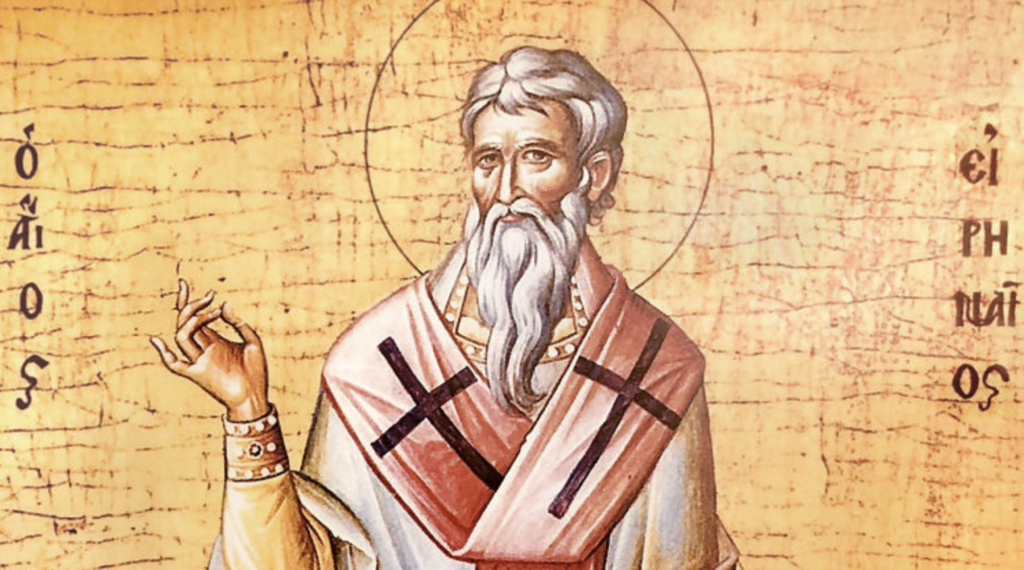
Irenaeus ; Ancient Greek: Εἰρηναῖος, romanized: Eirēnaîos; (125 AD– 202 AD) was a Greek bishop noted for his role in guiding and expanding Christian communities in the southern regions of present-day France and, more widely, for the development of Christian theology by opposing Gnostic interpretations of Christian Scripture and defending orthodoxy. Originating from Smyrna, he had seen and heard the preaching of Polycarp, who in turn was said to have heard John the Evangelist.
Chosen as Bishop of Lugdunum, now Lyon, Irenaeus wrote his best-known work Against Heresies around 180 as a refutation of gnosticism, in particular that of Valentinus. To counter the doctrines of the gnostic sects claiming secret wisdom, he offered three pillars of orthodoxy: the scriptures, the tradition said to be handed down from the apostles, and the teaching of the apostles’ successors. He is the earliest surviving witness to regard all four of the now-canonical gospels as essential.
Irenaeus is venerated as a saint in the Catholic Church, Anglican Church, Lutheran Churches, the Eastern Orthodox Church, the Oriental Orthodox Churches, and the Assyrian Church of the East. He was declared a Doctor of the Church in the Catholic Church by Pope Francis in 2022.
In the 180s AD, Irenaeus of Lyons established himself as the greatest theologian since the time of the apostles when he wrote A Refutation and Subversion of What is Falsely Called Knowledge—more commonly known as Against Heresies (the shortened title given the work by the church historian Eusebius)—and Presentation of the Apostolic Preaching.
These took strikingly different approaches: AH offered a painstaking analysis and criticism of various heretical perspectives, while Apostolic Preaching presented an extended summary of what Christians believe and teach. Both works presented the Christian faith winsomely, as the message proclaimed by Jesus Christ and his apostles and faithfully passed down through the church.
If you read one or the other, you get a clear picture of the Christian faith as it was taught and believed by the church in the late second century, a little less than a hundred years after the last of the apostles.
Irenaeus was a native of Asia Minor, where a stimulating intellectual-cultural tradition—the “Second Sophistic”—flourished, especially in Ephesus and Smyrna.
This academic approach focused on logic, dialectics, and rhetoric, as enriched by wide reading in the Greek philosophers and poets—basically, the best “secular” education available at the time. Irenaeus’s written works testify how well he imbibed this vibrant approach to learning.
Even more significant for Irenaeus’s formation, though, was his training under Polycarp, bishop of Smyrna. This impressive stalwart of the faith, a correspondent of Ignatius of Antioch (martyred c. 110), became a martyr in 155. In his youth, Polycarp had been trained by the apostle John, then in his old age; in Polycarp’s old age, a young Irenaeus received the training that shaped his approach to Scripture and the Christian faith.
Irenaeus was a spiritual grandson of the apostle John
So, when Irenaeus emphasized, as he regularly did in both his writings, the importance of faithfully passing on what the apostles had taught, he was himself only one step away from the apostles themselves: he was, after all, a spiritual grandson of the apostle John. Irenaeus knew well what he was writing about, and he urged that the genuine Christian message had been passed on, faithful to the apostolic tradition, within the church.
At some point subsequent to his training under Polycarp, but certainly before the latter’s martyrdom, Irenaeus—like many others who had been schooled in Asia Minor—headed westward, to Rome. While there, he may also have come under the tutelage of the renowned apologist, Justin Martyr.
Whether he did or not, though, Irenaeus spent his time in the imperial capital fruitfully, for he learned more about some of the various groups that claimed to be Christian but followed what he would later denounce as perversions of the Christian faith.
By personal conversation with some of their adherents, reading available written works, and scholarly investigation, Irenaeus discovered much of what he would later examine and refute in the first two books of AH. He also made the acquaintance of the leaders of the Roman church community before leaving, for unknown reasons, for Lyons (known at the time as Lugdunum).
Situated at the confluence of the Rhône and Saône rivers, Lyons had grown into a burgeoning trade center, becoming in due course the main city and capital of the province of Gaul (today’s France).
Excavations in contemporary Lyons and nearby Vienne have uncovered abundant evidence of spacious homes, warehouses, skilled products, and the accoutrements expected at the time in a Roman provincial imperial capital. The church in Lyons may have been the second major ecclesiastical plant in the west (after Rome itself). It was strategically located in one of the most significant centers in the Roman Empire.
Irenaeus became so well respected in the church in Lyons that he was appointed presbyter and was entrusted with an embassy to the bishop of Rome, Eleutherius, c. 177 AD. While he was absent, a violent persecution fell on the Christian church in Vienne and Lyons, which resulted in the martyrdom of many of its adherents, including its aged bishop, Pothinus.
Upon Irenaeus’s return, he was made bishop of the church there; he may have been the author of the “Letter from the Christians of Vienne and Lyons to their Brethren in Asia and Phrygia” (178 AD), which recounted the horrific persecution of scores of the Christian faithful.
Apostolic Preaching offers a presentation of the Christian faith, as proclaimed by the apostles and passed on in the church.
It shows how the church interpreted the Hebrew Scriptures (as rendered into Greek in the Septuagint), seeing them as fulfilled in the life, death, and resurrection of Jesus Christ. While Irenaeus was well acquainted with the Gospels and the apostles’ writings, he makes no use of them as he presents the Christian faith in this work.
This shows how carefully he presented his topic, “the apostolic preaching”: he only utilized as texts what the apostles could have utilized, and he presented them with the Christocentric focus they followed. Irenaeus was a careful scholar, faithful to his sources.
Irenaeus affirms that the “three articles” of faith—in God the Creator, in his Son, and in his Spirit—are the bedrock of the Christian message, as confessed at baptism and proclaimed in the constant preaching of the church.
(Long thought to be a lost work, an Armenian version of Apostolic Preaching was discovered in an ancient monastery in Erevan, Armenia, in 1904 and soon published in various translations. It has served to rejuvenate interest in Irenaeus’s thought and the teaching offered in early post-apostolic Christian circles.)
AH is easily the largest Christian work written in the first two centuries of Christianity.
In this hefty tome, Irenaeus presents the views of Gnostics and various other heretics (book 1), refutes them by showing their internal inconsistencies and their misuse of Scripture (book 2), and then offers (in books 3–5) the Christian faith as taught by Christ and the apostles and subsequently handed down within the church.
He forthrightly asserts that, unlike the teaching of his various opponents, the apostolic tradition everywhere in the church agreed in all regards with what was taught everywhere else in the church. Consequently, if one wanted the genuine article of the apostolic message—i.e., what Christ and the apostles had actually taught about him and what he had accomplished in fulfillment of all the scriptural teaching—one could find it in the churches founded by the apostles, where that apostolic tradition had been faithfully transmitted.
In AH Irenaeus makes abundant use of the Gospels and apostolic writings: indeed, he quotes from or alludes to all the works that would eventually be received into the New Testament canon except Philemon and 3 John.
This indicates how widely these works had already been disseminated in ecclesiastical circles by his time, how carefully Irenaeus had assimilated them, and how readily he used them as he interpreted the Septuagint.
Irenaeus differentiated among his various opponents, but he recognized common themes among them.